What is the Work of an Evangelist?

The book of Acts is full of examples of many different ways that Jesus’ disciples did the work of evangelism. Peter preached to crowds at Pentecost and made a house visit to Cornelius. Phillip preached to crowds in Samaria, but was carried to just one Ethiopian Eunuch to tell him about Jesus. 

There are many tools that can help us do the work of an evangelist. We are called to do the work, not just possess the items and knowledge.  With the resources we have, there is no excuse for us to ignore our calling.
Main Scripture

Acts 13:13-43

References

Acts 2, 8, 17

2 Tim 4:5

1 Peter 3:15

The Bible leaves no question that Jesus’ church should be evangelical, extending the good news to large groups, families, and individuals. We have a mandate to evangelize. Evangelism requires us to proclaim the gospel to unbelievers and to make disciples among those who have faith to believe the gospel. We can have people in the church who are better at some parts or methods of evangelism, but all believers need to be able to effectively communicate who Jesus is using the Bible as the basis for our understanding and call people to repent of sin and believe that this is the good news. 

As we pray and prepare for our worship this week, lets focus on evangelism, for our one, and for all those we encounter everyday who still need to be saved from sin.

This man came to Jesus by night…

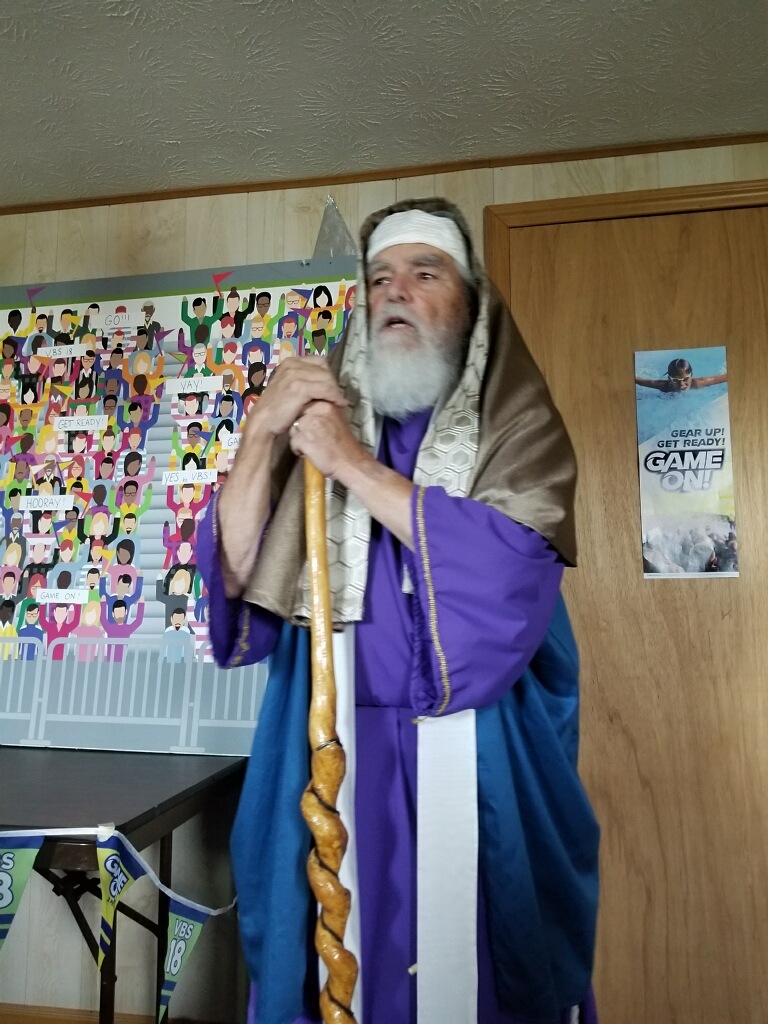
(Jim Fields as Nicodemus, VBS 2018)

This is the first time in several years that the students of our community have not been visited by Nicodemus.  Our Vacation Bible School was cancelled this year as a precaution against spreading the COVID-19 virus. Even in the heat of summer, Brother Jim Fields from First Baptist Somerset regularly dons the costume and persona of the First Century Pharisee who came to Jesus by night. It has become a cherished tradition and Brother Jim and his wife have, along with so many others from Somerset, been greatly missed this summer. Even more, we have missed the time of teaching, explaining and rejoicing with students in our community that God loves us and sent his Son to save us.

For God so loved the world, that he gave his only Son, that whoever believes in him should not perish but have eternal life.
John 3:16, ESV

Even as Nicodemus struggled to understand Jesus’ identity and message, he saw the goodness and godliness of both. Jesus met with him in secret, known only to his close followers, and the account that John preserves in his gospel has become one of the most cherished passages for preaching and teaching the good news that Jesus is the Son of God and came to the world to save sinners.

The third chapter of John gives us a great example of how Jesus taught his disciples and how he took time to answer the questions and concerns of just one person who came to him with doubts and left without completely resolving them. As we read this chapter and prepare for worship together this week, let us pray that others will be born again to see and enter Jesus’ kingdom, receiving his testimony by the work of the Holy Spirit. 

We missed VBS this year. But there are plenty of ways to evangelize; spread the good news, the gospel, or the evangel, that are pandemic-proof. The gathering of Jesus and a few of his closest, earliest followers with Nicodemus was well within the constraints of our modern need for “social distancing.” And this stands in God’s Word as one of the greatest examples of personal evangelism, performed by the only perfect person, the Son of God, “because of the great love with which he has loved us…”

Faithfully Preach God’s Word

“Having purified your souls by your obedience to the truth for a sincere brotherly love, love one another from a pure heart, since you have been born again, not of perishable seed but of imperishable, through the living and abiding word of God…”
1 Peter 1:22-23

Scriptures

Jeremiah 23 (main sermon text)

Acts 2, 13 (Examples of New Testament sermons)

1 Peter 1:22-25 

Defining Preaching by What It Isn’t

I remember my the first “sermon” I ever preached. 

I had no idea what I was doing. I haven’t been able to find the notes. I am glad it wasn’t recorded.

I do remember the scripture from which I tried to preach. It was Zechariah chapter 8. I chose the text to try to cast a vision for our church to pursue renewal and growth. This was, I think about 14 years ago.

I can now see that I started with what I wanted to say to people and found a passage of scripture that I thought I could us to support my ideas for what  our church needed to do. Jeremiah warns against prophets or preachers who preach from a starting point of their own visions or dreams.

Preaching is not just presenting our personal convictions, even convictions faithfully held and based upon Scripture. Preaching starts with studying to understand what the Bible passage really means and how it should be applied. Most Christians will never and should never preach a formal sermon (James 3:1), but every Christian should be ready to give a defense of the reason for the hope that is in us, and to do so with gentleness and respect (1 Peter 3:15). Even for those of us who will never preach to a crowd, we have to preach the word to ourselves. That means we read the Bible to know what it is saying. We should be careful not to go to the Bible with a conclusion already in mind. A healthy church requires members to read and study and leaders to read, study, teach, and preach the word faithful to what the word says. 

Calling Leaders in Faith

Much of the history of Campton has been lost. Our local courthouse, which housed many records, has burned… twice.

Much of our history has also been recovered and preserved through the work of many local volunteers and by the mercy of God. 

Our church was sent an important part of our history in 2009. We received a package from Connie Hoskins of Beaver Dam, KY which contained what appears to be the original church record book of Swift Camp Church, which was founded even before the town that would one day be called Campton, Kentucky. 

In the book, which was according the records therein, purchased by the church for $1.60, we find the original articles of confession of the church that would eventually become Campton Baptist Church. The leaders of that first church who signed the confession of faith are identified as the Elders William Boothe and John D. Spencer. Other founding leaders identified include C.M. Hanks and Elkanah Garrett, both serving as clerk.

Scriptures on Church Leadership Qualifications

1 Timothy 3:1-13

Titus 1:5-11

Today, we want to pray for the needs of our church and our community. These founding members of our church thought to organize and establish a church, even as they were just forming a town. This shows that they could not imagine a community in which there was not a church to proclaim the good news of Jesus and make disciples in his name. 

As we prepare for our worship together on Sunday, I encourage us to reflect on these scriptures that emphasize the characteristics of leaders in the church. Remember that we are seeking the help of a church member to lead us by example in these qualities that are all commended and many commanded to be the fruit of the Spirit in all men and women who would follow the Lord Jesus. 


Our First Confessions of Faith

The following are a lightly edited (for clarity) transcription of the original first 7 articles of faith for the Swifts Camp Church, from July 8th, 1848. These confirm the tradition of faith once and for all delivered unto the saints,  that we have received by grace and in which we hope to continue.

01

Of Scripture

On the Scriptures of the Old & New Testaments, believing them to be the infallible word of God & the only rule of faith & practice.

02

Of God

We believe in one true & living God, Father, Son, & Holy Ghost, but one God.

03

Of Human Sin

We believe in the fall of man in their federal head & that it has corrupted the whole of Adams posterity & the total inability of recovering himself, Either in part or in whole.

04

Of Salvation

We believe in the doctrine & Election according to the foreknowledge of God & we believe that only in the imputed Righteousness of Jesus Christ there is salvation.

05

Of Perseverance

We believe that the saints will finally persevere in grace to glory & not one of them will be finally lost.

06

Of the Resurrection

We believe that there will be a Resurrection of the dead, both of the just & unjust and that the happiness of the Righteous & the punishment of the wicked will be eternal.

07

Of the Church

We believe the Church of Jesus Christ to be a body of members that has witnessed their sins pardoned & have give(n) themselves to the Lord & to one another by professing their Christ & being Baptized by immersion by a Regular ordained Baptist Preacher, ordained by the laying on of the hand & a Prayer of two or more ordained Baptist preachers Chosen by the Baptist Church.

Hebrews 11:20-39

(James 2:14-26; Matthew 5:17-20, Romans 9)

Our nation is in distress. When I began praying over the text for the sermon this week, I was too. I have been pulled over by police five times in my life. Only one of those times was I certain I was doing something seriously wrong. It was only that time that I was truly fearful. I won’t go into detail, but 19-year-old males often drive and act foolishly . Hopefully, they live to tell about it.

When I see a uniformed police officer in a public place or a patrol car on the highway, I feel immediately more secure. I have almost no cultural frame of reference for people who feel afraid or threatened by police presence, but I recognize that people aren’t lying when they say they worry about being unjustly targeted because of their ethnicity or appearance. We can debate on the reasons for this sense of injustice, but we should not dismiss the voices of those who speak from another cultural perspective. This isn’t some notion of privilege, intersectionality, or Marxist critical race theory. This is just listening to people made in the image of God.

I don’t think politics should be the main goal of any prayer or sermon in a church, but sometimes it is unavoidable. This is one of those times. This scripture in Hebrews and our present context makes it necessary. 

I don’t think politics should be the main goal of any prayer or sermon in a church, but sometimes it is unavoidable. This is one of those times.

photo credit: BoldGrid Commons

“For I tell you, unless your righteousness exceeds that of the scribes and the Pharisees, you will never enter the kingdom of heaven”  -Matthew 5:20

“So also, faith, by itself, if it does not have works, is dead… For as the body apart from the Spirit is dead, so also faith apart from works is dead.”                               -James 3:17, 26

The writer of Hebrews makes clear in chapter 11 that it takes more than courage to meet unrighteousness with righteousness. It takes faith. It takes a strength of resolve that goes above mere human ability. Humanity saw that with Dr. King, the freedom riders, and other leaders of the American civil rights movement. Humanity saw that with William Wilberforce, John Newton, and Fredrick Douglass with the work to abolish slavery. It will take faith to overcome the national sins of “These Yet to be United States.” 

We are not made righteous by our actions. That is half the message of Hebrews 11. Even people who think they are acting for justice can act very unjustly. Even the actions that may work for goodness in the world do no profit the unbeliever who is ultimately condemned for rejecting the Son of God. It is faith alone in Christ’s atoning life, death, and resurrection that makes us righteous before God because he is righteous as God.

But the second half of the message of Hebrews chapter 11 is that we are not made righteous apart from our actions also being made righteous. Christ does not save us to let us remain in sin or ignore the problems of unrighteousness in our world. That includes, first, doing less unrighteousness personally, and then working to make righteousness the law and practice of our communities. In a democratic society, we have the privilege and responsibility to call for laws that promote righteousness and oppose unrighteousness.

We see that in the story of Moses and the Exodus, there was the enslavement and oppression of people based on race and the selective killing of infants in the name of population control. If we cannot draw a straight line from there to our present context, then we are blind or blindfolded. Right now the two greatest sins in our nation are racism (racial or ethnic prejudice or hostility) and abortion (ending the life of a human being before birth). No one really disputes that these two things happen, but we do seem divided as a nation on whether they are problems that need to be solved by laws. Some dispute whether either or both of them are problems at all. Thankfully, not too many people are still openly championing racism, but too many deny that there remains a systemic problem of racial prejudice. 

Both sins deny the fundamental truth that all humans, regardless of sex, age, and level of independence are equally created in the image of God and have should therefore have equal dignity and protection. We see the sins of infanticide and racial prejudice as evils to be judged as such in the history of Moses and the Exodus. We see the judgment of God against such unrighteousness will be severe and wide-reaching. He doesn’t just judge leaders of nations, but he will judge entire nations for the evil of denying the dignity of his image-bearers. He places foolish, prideful, corrupt, and wicked leaders over nations as a judgment against them. Our churches cannot be silent on these issues, because as God’s people here in this nation, we suffer or succeed along with our neighbors. If we do not have faithful works that testify to the righteousness of Christ, then we probably don’t have saving faith that he really is God the Son. It will take a mighty faith and people of faith to stand against the evils that plague our nation. If we leave it to unbelievers alone to speak for the changes that need to happen, then we sentence our nation and ourselves to judgement.

Pray for our nation and our leaders. Pray for our churches in our nation. Pray for people to repent and believe the gospel. Pray for peace and justice. Pray for righteousness that comes only by faith in Christ.